Dead Towers, Living Communities: The People Who Moved Into America's Forgotten Radio Stations
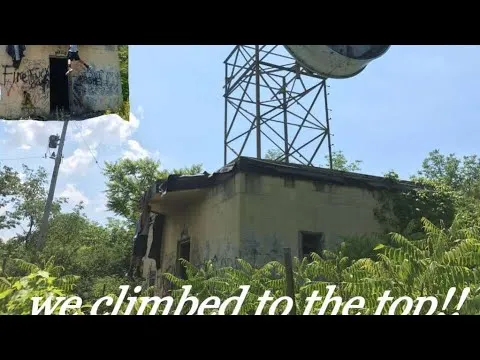
Photo: abandoned rural radio station transmitter tower overgrown building, via i.ytimg.com
The studio smells like old carpet and ozone. There's a console that hasn't been powered on in eleven years sitting against one wall, its VU meters frozen at zero, a coffee mug still parked on the shelf above it like someone just stepped out. The transmitter room down the hall hums — not from the transmitter, which is dead, but from a space heater someone dragged in last winter and never moved. On the whiteboard by the door, in faded dry-erase marker, is a programming schedule from 2013.
This is KXXX-FM, somewhere in the high desert of eastern Oregon. The call letters have been changed because the people using this building don't exactly have permission to be here, and they'd like to keep using it. There are maybe fifteen of them, loosely affiliated, who show up on weekends to record oral histories from ranchers and farmworkers, archive old station recordings they've rescued from a storage unit, and occasionally broadcast low-power experimental audio into the surrounding forty miles of scrubland.
They are not unique.
The Afterlife of the Broadcast Era
America built an extraordinary number of radio stations in the twentieth century. The economics that justified most of them — local advertising, community licensing requirements, the genuine scarcity of broadcast spectrum — have shifted dramatically. Consolidation gutted local ownership. Satellite and streaming ate into audiences. Automation replaced staff. And when a station becomes financially unviable, what's left is a building, a tower, and a lot of equipment that's too expensive to remove and not worth enough to bother.
The FCC estimates there are hundreds of licensed broadcast facilities across the US that are technically operational but functionally dormant — running automated feeds with no local staff, no local programming, and no meaningful community presence. Beyond those, an unknown number of facilities have had their licenses lapse entirely, leaving physical infrastructure in various states of ownership ambiguity.
It's that ambiguity that creates the opening.
"Most of these buildings are owned by someone," explains Marcus Webb, who runs a small nonprofit in rural Mississippi dedicated to preserving local broadcast history. "But the owner is often a holding company that bought the license years ago, or an estate that hasn't been settled, or a county that took the property for back taxes and doesn't know what to do with it. In practice, nobody's watching. And a building that nobody's watching starts to attract people who need a space."
Archives Before They're Gone
The most organized of these informal communities tend to form around a specific, urgent mission: saving the recordings. Broadcast facilities accumulated enormous archives over their operating lives — not just music, but local news recordings, community meeting coverage, call-in shows, sports broadcasts, oral histories conducted by long-gone staff, advertising jingles that are the only surviving audio record of businesses that closed decades ago.
When a station shuts down, those archives are almost never systematically preserved. Tapes end up in dumpsters, storage units, or basements. Hard drives get wiped. The institutional knowledge of what exists and where it is walks out the door with the last employee.
In rural Alabama, a group called the Wiregrass Audio Preservation Project has been quietly working through the archived holdings of four defunct stations over the past six years. They operate out of a former AM station building that the county owns but has no plans for, under an informal arrangement that everyone involved describes as "we asked and nobody said no."
"We've found things that are genuinely irreplaceable," says one of the project's founders, who asked to be identified only as Terri. "Recordings of civil rights meetings from the 1960s. Interviews with farmers talking about the boll weevil. A complete run of high school football broadcasts from 1958 to 1979. None of this exists anywhere else. We're racing against the tapes degrading faster than we can digitize them."
Experimental Static
Not everyone using these spaces is primarily interested in preservation. Some are there to make something new.
In the Midwest, a loosely organized collective of sound artists and experimental musicians has been working out of a decommissioned AM facility in rural Iowa. The building's transmitter is offline, but the antenna is still standing, and the collective has rigged up a low-power FM setup that broadcasts a rotating schedule of experimental audio — ambient compositions, field recordings, long-form spoken word pieces, occasional live performances — to an audience that's mostly truckers on the interstate and a handful of locals who stumbled onto the frequency.
"There's something about broadcasting into empty space that changes how you make things," says one collective member, who goes by the handle Nullpoint. "You're not performing for an audience. You're sending a signal into the landscape. It's closer to planting a flag than putting on a show."
The legal status of their operation exists in a gray zone they're acutely aware of. Low-power FM broadcasting requires an FCC license. They don't have one. They operate at low enough power that they're unlikely to interfere with licensed stations, which keeps them off the agency's enforcement radar — in theory. "We're not trying to be pirates," Nullpoint says. "We're trying to be archaeologists. We're using old infrastructure to ask what broadcasting was actually for."
The Legal Gray Zone
The legal landscape for these informal occupants is genuinely complicated, and it varies significantly depending on how they're using the space and who technically owns it. Occupying a building without permission is trespassing regardless of how benign the purpose. Broadcasting without a license is an FCC violation regardless of power level. Touching transmission equipment that belongs to someone else creates liability exposure.
Most of the communities navigating this terrain do so through a combination of careful relationship-building with property owners, deliberate ambiguity about their activities, and a calculated bet that nobody with enforcement authority is paying close enough attention to small-scale operations in rural areas.
Some have found more legitimate footing. A few have formalized their arrangements through lease agreements with sympathetic landowners. Others have applied for low-power FM licenses through the FCC's community broadcasting framework. The Wiregrass group is pursuing nonprofit status that would let them make a formal case for stewardship of the property they're using.
"The system wasn't really built for what we're doing," Terri says. "But the history wasn't going to save itself."
Frequency as Place
What connects these scattered communities — the archivists, the experimenters, the historians, the hobbyists — is a shared intuition that radio stations are more than technical infrastructure. They're places where communities told themselves stories, heard their own voices reflected back, argued about what mattered and what didn't. When that function disappears, something real is lost.
The people moving into these dead towers aren't trying to bring commercial radio back. They're doing something stranger and more interesting: treating the infrastructure of mass communication as a found object, a historical artifact, a creative tool, and occasionally a home.
The towers are still standing. The frequencies are still there. Someone's always going to find a use for a signal.