Below the Streets: What's Still Moving Through America's Dead Internet Infrastructure
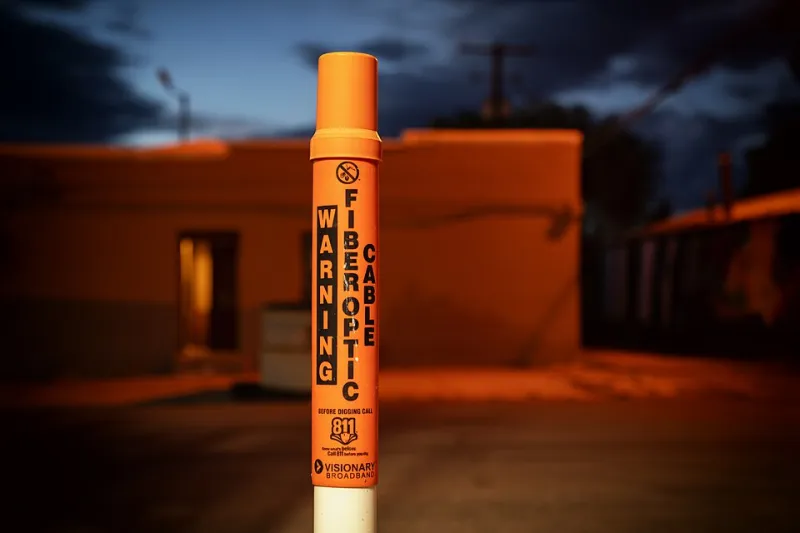
Photo: Tony Webster, CC BY 2.0, via Wikimedia Commons
The internet you use exists on top of another internet. And beneath that, probably another one. American cities are layered with decades of telecommunications infrastructure — fiber optic runs, coaxial trunk lines, copper pairs — much of it installed by companies that no longer exist, for contracts that expired before some of its current neighbors were born. A significant portion of it was never decommissioned. It was just abandoned in place, because digging it back up costs more than leaving it there.
Some of it, against most reasonable expectations, is still doing something.
The Economics of Abandonment
To understand why dead infrastructure sticks around, you have to understand how telecom buildouts actually work. When a carrier lays fiber or copper through a city, they're pulling cable through conduit — essentially plastic pipes that run under streets, through utility tunnels, and between buildings. The conduit itself is expensive to install. The cable inside is relatively cheap.
When a carrier goes bankrupt, gets acquired, or simply decides a route isn't profitable, the calculus almost always lands in the same place: leave the cable, maybe sell the conduit rights if anyone wants them, move on. The result is that major American cities — New York, Chicago, Los Angeles, Atlanta — have conduit systems full of cable from carriers that dissolved in the dot-com bust, from overbuilt 1990s fiber rings that never found customers, from regional telephone companies absorbed into larger entities that didn't bother to audit what they'd inherited.
Telecom historians sometimes call this "dark fiber" — cable that was installed but never lit, or was lit and then abandoned. But dark fiber is actually the clean version of this story. The messier version involves infrastructure that wasn't cleanly shut down.
Residual Signal
Fiber optic cable, when it's carrying data, is doing so via pulses of light. When you shut down a fiber link properly, you power down the transceivers at each end and the light stops. Clean. But "properly" requires someone to actually do it — and in the chaotic aftermaths of acquisitions, bankruptcies, and network reorganizations, proper decommissioning doesn't always happen.
Engineers who've worked in legacy network infrastructure describe finding live fiber links attached to equipment that had no business still being powered — routers sitting in dusty colocation cages, still drawing electricity from circuits billed to accounts nobody was monitoring, still passing packets to destinations that may or may not still exist. The internet, at its lower layers, is remarkably persistent. BGP routes propagate. Packets find paths. Old equipment, if it's powered and connected, keeps doing what it was configured to do.
There's a category of network anomaly sometimes called a "ghost route" — a path through the internet that appears in routing tables but leads somewhere unexpected or unaccounted for. Network engineers occasionally stumble across traffic flowing through infrastructure they didn't know was active, routing through autonomous system numbers assigned to defunct companies, terminating at IP blocks that were supposed to have been reallocated years ago. It's not common. But it happens.
The Copper Problem
Fiber gets the attention, but copper is the weirder story. The United States still has an enormous installed base of copper telephone infrastructure — the legacy PSTN plant that AT&T and the Baby Bells built over a century and that nobody has fully replaced. The FCC has been slowly managing copper retirement for years, but "retirement" in telecom is a process measured in decades.
Old copper pairs do strange things. They pick up interference. They develop phantom circuits — electrical paths created by the capacitive coupling between adjacent wire pairs that can carry low-bandwidth signals without any intentional connection. Telephone technicians have been dealing with phantom circuits since the nineteenth century; they're well understood and mostly harmless. But in dense urban cable bundles, the interactions get complicated.
Some archivists and phone phreaks — yes, phone phreaking is still a thing, practiced by a small community of people who find the PSTN genuinely fascinating — have documented legacy copper infrastructure carrying what appear to be automated system tones and signaling traffic from equipment that should have been decommissioned. Old PBX systems, alarm dialers, telemetry equipment installed in buildings and then forgotten when the buildings changed hands. These devices keep calling out, keep sending their little automated check-ins, into a network that mostly doesn't care anymore.
Archaeology in the Dark
For a certain type of person, this is all extremely interesting. There's a small but dedicated community of network archaeologists — a term some of them use themselves — who've made it their project to document what's still out there.
Some work from the outside, using publicly available tools to probe IP space assigned to defunct carriers, mapping what still responds. Others work from the inside, employed by the infrastructure companies that inherited legacy assets and tasked with figuring out what they actually own. The stories they tell in private — because most of them work under NDAs — involve finding active network equipment in locations nobody had documented, traffic flowing through paths that weren't in any diagram, data that had been looping through isolated network segments for years with no origin or destination anyone could identify.
The archivist angle is distinct but related. Organizations like the Internet Archive have done tremendous work preserving the content layer of the early web. But the infrastructure layer — the actual physical and logical architecture of how the 1990s internet was built and how it fell apart — is mostly undocumented. Some researchers are trying to change that, pulling together records from FCC filings, bankruptcy proceedings, and the memories of engineers who were there, building maps of a network that no longer exists in the form it once did but whose bones are still underfoot.
What It Means That It's Still There
There's something genuinely odd about the fact that the physical substrate of the early internet is still buried under American cities, still occasionally active, still mostly unexamined. We tend to think of digital infrastructure as ephemeral — data here, data gone — but the hardware reality is almost geological. Layers of investment, layers of abandonment, compressed under streets and forgotten.
The ghost data moving through some of these systems isn't meaningful in any conventional sense. It's not a message. It's more like the electrical equivalent of a building that still has the previous tenant's mail piling up in the lobby — automated signals from systems nobody told to stop, routing through paths nobody thought to close.
But there's something worth sitting with in the image of a packet finding its way through a network built by a company that dissolved in 2002, traveling through conduit installed under a street that's been repaved four times since, arriving at a router that nobody has logged into in a decade. The internet was built to route around damage. It turns out it also routes around neglect, around bankruptcy, around the simple human failure to turn things off.
The signal persists. It just doesn't know why anymore.